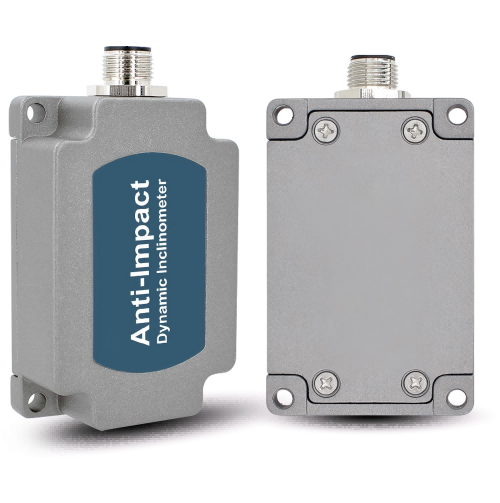
Product Details
Place of Origin: China
Brand Name: RION
Certification: CE, FCC , ROHS
Model Number: HDA446T
Document: HDA446T DIGITAL OUTPUT DYNA...OR.pdf
Payment & Shipping Terms
Minimum Order Quantity: 1
Price: $56.00/Pieces
Packaging Details: Carton
Delivery Time: 5~8 work days
Payment Terms: T/T
Supply Ability: 3000/Month
Anti-vibration: |
10grms / 10~1000Hz |
Output Optional: |
RS485/232/TTL |
Static Accuracy: |
± 0.05° |
Weight: |
≤165g (Without Cable) |
Wide Voltage Input: |
DC 9~36V |
Protection Level Optional: |
IP67/IP68 |
Anti-vibration: |
10grms / 10~1000Hz |
Output Optional: |
RS485/232/TTL |
Static Accuracy: |
± 0.05° |
Weight: |
≤165g (Without Cable) |
Wide Voltage Input: |
DC 9~36V |
Protection Level Optional: |
IP67/IP68 |
APPLICATION FIELD
WORKING PRINCIPLE
It adopts imported core control unit and uses the principle of capacitive miniature pendulum. According to the earth gravity principle, when the dip angle unit is inclined, the gravity of the earth can generate a gravity component on the corresponding pendulum, the corresponding capacitance can be changed, and the dip angle can be obtained by amplifying, filtering and converting the capacitance.
MAIN FEATURES
INSTALLATION AXIAL
HDA446T uses the ENU coordinate system, a right-hand system. According to the rotation order of Z-X-Y, when the positive direction of the Y axis points to the front of the carrier, the angle rotated around the Z axis is the heading angle, the angle rotated around the X axis is the pitch angle, and the angle rotated around the Y axis is the roll angle.
SPECIFICATIONS
| HDA446T-C1 | Condition | Parameter | |
| Measure Range | - | X ±90°, Y ±90° | |
| Measure Axis | - | X-axis/Y-axis | |
| Roll&Pitch Static Accuracy | @25℃ | ±0.05° | |
| Roll&Pitch Dynamic Accuracy (RMS) 1) | @25℃ | ±0.1° | |
| Gyroscope | Gyroscope Range | - | ±300°/s |
| Zero-Bias Stability (10s smooth) | - | 8.5°/h | |
| Angular Random Walk Coefficient (Allan) | - | 0.25°/sqrt(h) | |
| Acceleration | Acceleration Range | - | ±4g ±16g optional |
| Zero-Bias Stability (10s Average) | - | 0.02mg | |
| Zero-Bias Instability (Allan) | - | 0.005mg | |
| Velocity Random Walk Coefficient (Allan) | - | 0.005m/s/sqrt(h) | |
| Zero Temperature Coefficient 2) | -40~85℃ | ±0.01°/℃ | |
| Temperature Coefficient Of Sensitivity 3) | -40~85℃ | ≤100ppm/℃ | |
| Power-On Start Time | ≤3.5S | ||
| Response Time | 0.01S | ||
| Output Signal | CANOpen | ||
| Electromagnetic Compatibility | According to EN61000 and GBT17626 | ||
| MTBF | ≥ 98,000 hours/time | ||
| Insulation Resistance | ≥ 100 megohm | ||
| Impact Resistance | 100g @ 11ms, triaxial (half sine wave) | ||
| Vibration Resistance | 10grms / 10~1000Hz | ||
| Waterproof Grade | Standard IP67, optional IP68 and corrosion-resistant IP68 protection level | ||
| Weight | Single connector ≤165g / double connector ≤180g (excluding cable) | ||
|
FAQ
1. What is a wind turbine blade pitch attitude sensor?
A wind turbine blade pitch attitude sensor is designed to monitor the real-time three-dimensional attitude of wind turbine blades. It can provide roll, pitch and azimuth data for blade attitude monitoring, operational analysis and control optimization.
2. What can a blade attitude sensor monitor?
The sensor can monitor the real-time attitude changes of wind turbine blades, providing three-dimensional motion and attitude data. This information can be used for blade pitch monitoring, operating condition analysis and blade clearance assessment.
3. How can blade attitude monitoring improve wind turbine performance?
Real-time blade attitude data can provide a basis for optimizing pitch control and operating strategies. Under suitable turbine configurations and operating conditions, the monitoring data can support improvements in power generation efficiency.
4. Can the sensor help reduce wind turbine blade clearance risks?
Yes. Real-time three-dimensional blade attitude monitoring provides data for analyzing blade clearance and identifying abnormal attitude changes, helping operators assess potential clearance risks and improve turbine safety monitoring.
5. Where is the wind turbine blade attitude sensor installed?
The sensor can be installed on the wind turbine blade or at the designated blade monitoring position according to the specific turbine structure and monitoring requirements. Its convenient installation makes it suitable for long-term online monitoring.
6. How long is the service life of the blade monitoring sensor?
The theoretical service life of the sensor is more than 9 years, making it suitable for long-term online monitoring applications in wind turbines.